
When a closely held business or professional practice is valued in an Alaska divorce or ownership dispute, goodwill is often the most contested component of value. Parties frequently assume that strong earnings, long client relationships, or a respected reputation automatically translate into divisible business goodwill.
Alaska courts have been clear: that assumption is wrong.
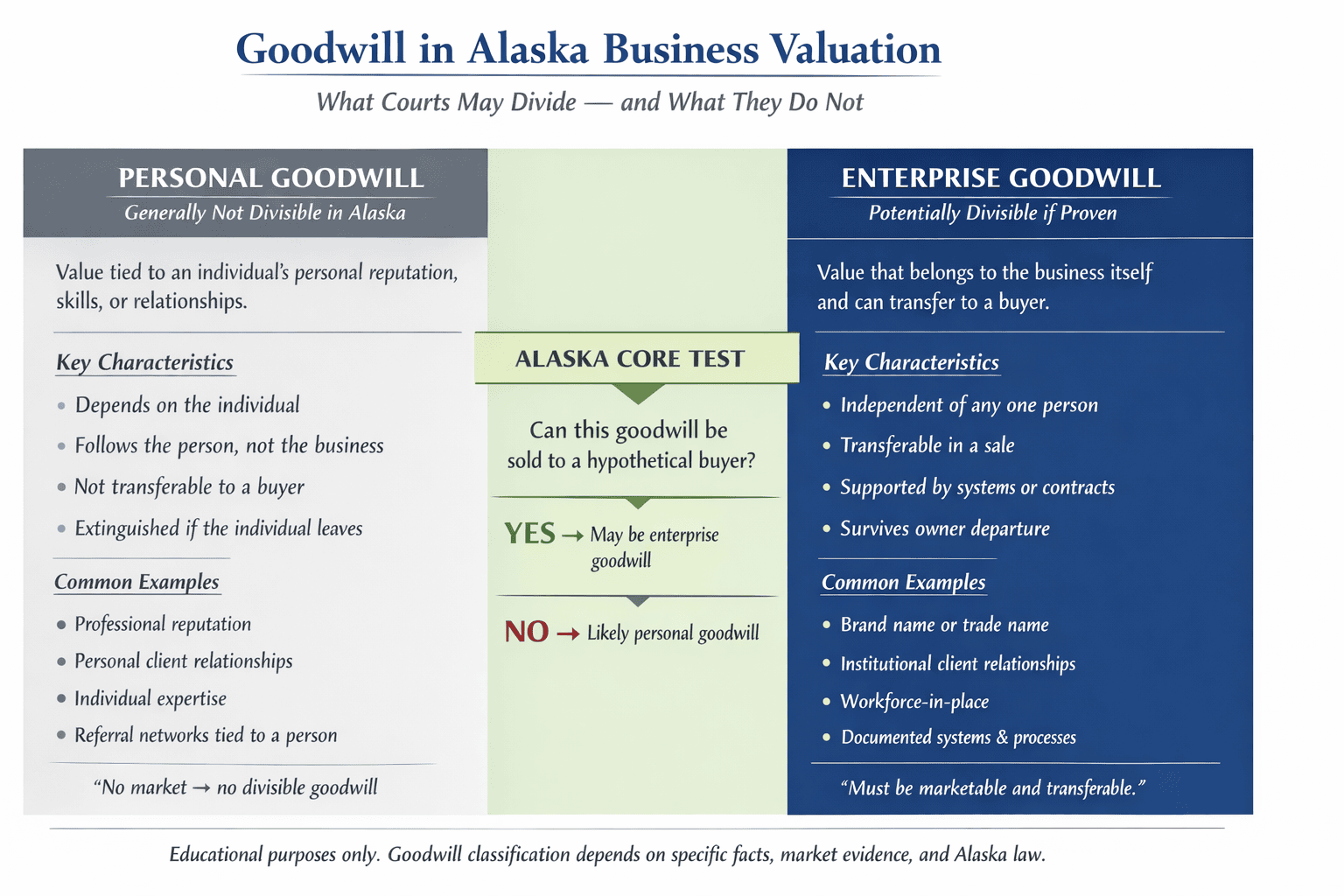
Under Alaska law, only goodwill that is transferable, marketable, and independent of the individual owner may be included in a divisible business interest. Goodwill that depends on the personal reputation, skills, or continued presence of an individual is generally personal goodwill and not subject to division.
Understanding this distinction and applying it correctly in a valuation is critical for attorneys, litigants, and valuation experts.
What Is Goodwill in a Business Valuation?
In valuation terms, goodwill represents the portion of a business’s value that exceeds the fair market value of its identifiable tangible and intangible assets. It often reflects factors such as:
- Established customer relationships
- Brand recognition
- Workforce-in-place
- Operating systems and processes
- Expected future earnings beyond a normal return on assets
However, valuation theory distinguishes between two very different types of goodwill.
Enterprise Goodwill
Enterprise goodwill:
- Attaches to the business entity itself
- Exists independently of a specific owner
- Is transferable to a buyer
- May be sold, pledged, or retained after an owner’s departure
Enterprise goodwill can survive a change in ownership and therefore may be subject to division.
Personal Goodwill
Personal goodwill:
- Is inseparable from an individual’s personal reputation, skills, or relationships
- Depends on the continued involvement of a specific person
- Is not transferable
- Is typically extinguished if the individual leaves the business
Personal goodwill is generally not divisible under Alaska law.
Alaska Supreme Court Guidance: “No Market, No Value”
The Alaska Supreme Court has consistently emphasized that goodwill must be marketable to be divisible.
In May v. Petersen (2025), the Court rejected the inclusion of goodwill in a law firm valuation where there was no evidence that the goodwill could be sold, transferred, or pledged. The Court made clear that:
- High earnings alone do not establish enterprise goodwill
- Reputation-based value tied to a professional is personal goodwill
- Without a demonstrable market, goodwill has no divisible value
The Court’s reasoning reinforces a practical rule applied in Alaska cases:
If goodwill cannot be sold or transferred to a hypothetical buyer, it does not belong in the marital estate.
Why Professional Practices Are Especially Vulnerable to Error
Goodwill disputes most often arise in:
- Law practices
- Medical and dental practices
- Accounting firms
- Consulting and service-based businesses
- Owner-dependent trades
In these businesses, revenue frequently follows the individual rather than the entity. Alaska courts are skeptical of valuations that:
- Capitalize excess earnings without isolating personal effort
- Assume clients will remain after the owner’s departure
- Ignore enforceability and duration of non-compete agreements
- Fail to identify transferable assets supporting goodwill
A valuation that does not separate personal earning capacity from enterprise value risks overstating goodwill and losing credibility.
How Alaska Courts Evaluate Goodwill Evidence
Although Alaska does not mandate a single valuation method, courts consistently examine whether the expert has addressed the marketability and transferability of goodwill. Factors often considered include:
- Existence of binding non-compete agreements
- Ability to replace the owner without material revenue loss
- Presence of institutional versus personal clients
- Evidence of comparable business sales
- Whether goodwill survives a hypothetical sale
Courts look beyond labels. Simply calling goodwill “enterprise goodwill” does not make it so. The conclusion must be supported by facts, not assumptions.
Common Valuation Mistakes Courts Reject
Goodwill conclusions are frequently challenged when experts:
- Apply capitalization methods mechanically
- Rely solely on excess earnings models
- Ignore Alaska’s smaller, relationship-driven markets
- Fail to test actual transferability
- Conflate earning capacity with business value
These weaknesses often surface under cross-examination and can materially affect case outcomes.
Practical Implications for Attorneys and Litigants
For attorneys:
- Scrutinize how goodwill is identified and supported
- Ask whether a hypothetical buyer could realistically acquire it
- Challenge unsupported assumptions early
For business owners:
- Do not assume all business value is divisible
- Understand how owner dependence affects valuation
- Recognize that goodwill treatment varies by jurisdiction
For valuation experts:
- Clearly distinguish personal and enterprise goodwill
- Tie conclusions to market evidence
- Document assumptions with Alaska-specific facts
Why Independent Valuation Judgment Matters
Goodwill analysis requires professional judgment, not formulaic application of models. Alaska courts expect valuation experts to apply independent judgment consistent with professional standards and economic reality.
Valuations that acknowledge uncertainty, explain limitations, and align with Alaska case law tend to carry greater weight than those that overreach.
Final Thought
In Alaska, goodwill is not presumed—it must be proven.
When goodwill cannot be sold, transferred, or separated from the individual, Alaska courts have shown they are willing to assign it no divisible value at all. For disputes involving closely held businesses or professional practices, careful goodwill analysis is not optional; it is central to a credible valuation.